
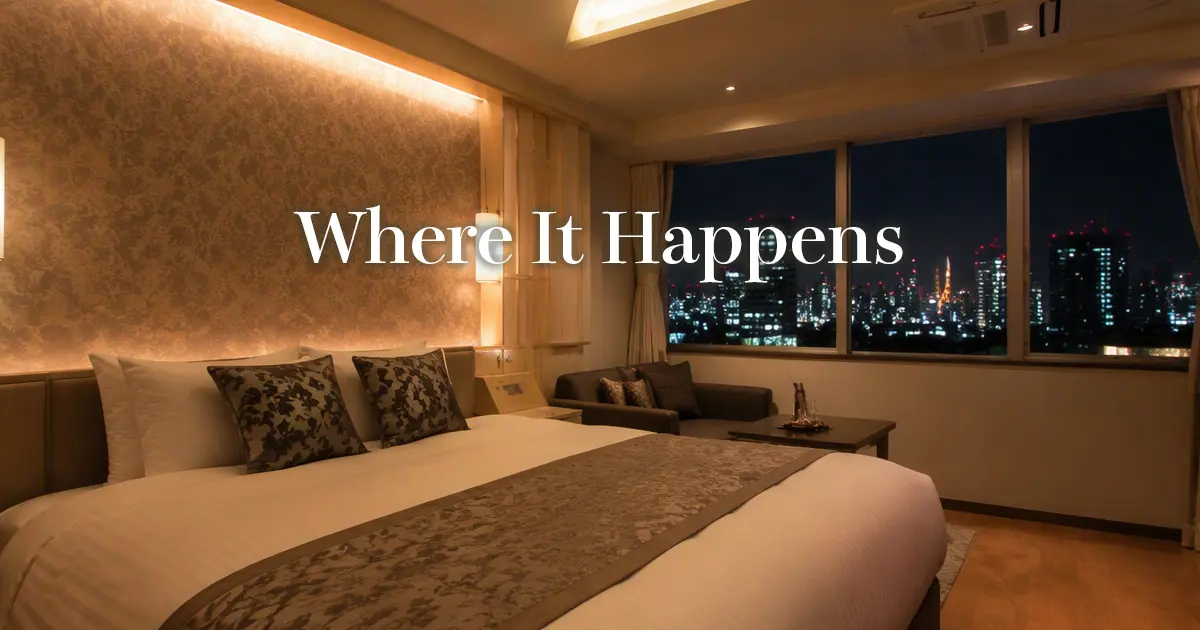
You’ve read about women-only sensual massage in Tokyo. Maybe you’ve even short-listed a therapist. And then one very practical question stops you mid-scroll: where does this actually happen? If the answer is “a love hotel” — a place you may never have set foot in, let alone walked into alone — a little hesitation is completely natural. This guide is for that exact moment: what a love hotel is really like for a woman on her own, what it costs, and how your session unfolds once the door clicks shut.
Most guides to erotic massage for women cover the what — the counseling, the touch, the pacing. Almost none cover the where. Yet for Japan’s women-only sensual services, MIKADO included, the venue is half the experience: Tokyo sessions are outcall, and for many guests the room in question is a love hotel. (Still at the “what even is this?” stage? Start with the complete first-timer’s guide to erotic massage for women in Tokyo, then come back — this article picks up where it leaves off.)
Why a Love Hotel Is the Standard Venue, Not a Backup Plan
MIKADO has no storefront to walk into in Tokyo — by design. It’s a women-only outcall service: a professional male therapist comes to you, at your hotel or your home, from 08:00 until late at night. You stay on territory you control. But home isn’t always an option. Roommates, family, thin walls — or simply not wanting anyone to know your address — are all perfectly good reasons. Many mainstream hotels, especially international chains, prohibit unregistered visitors in guest rooms, and capsule hotels and hostels offer no truly private space at all.
Here’s the part almost nobody writes down: check the fine print of Tokyo’s general outcall relaxation companies and you’ll find that many explicitly refuse to dispatch to love hotels — along with capsule hotels and, often, private homes. Women’s sensual services are built the other way around. At MIKADO, the love hotel is the standard, expected venue. Since September 2021, the service has delivered about 40,000 sessions — a great many of them in rooms exactly like these — through about 140 male therapists across 23 locations nationwide (8 directly managed and 15 franchise). Among first-time guests, about 60% return. Whatever picture the phrase “love hotel” conjures for you, the reality clearly isn’t scaring anyone off.
A love hotel is, quite literally, a room engineered for private time between two people: anonymous entry, a generous bath, fresh linens, and staff whose entire job is not noticing you. For a women-only sensual session, it isn’t a compromise venue — it’s the best-designed room in the city.
Walking Into a Love Hotel Alone: What It’s Actually Like
The entrance is designed so you meet almost no one
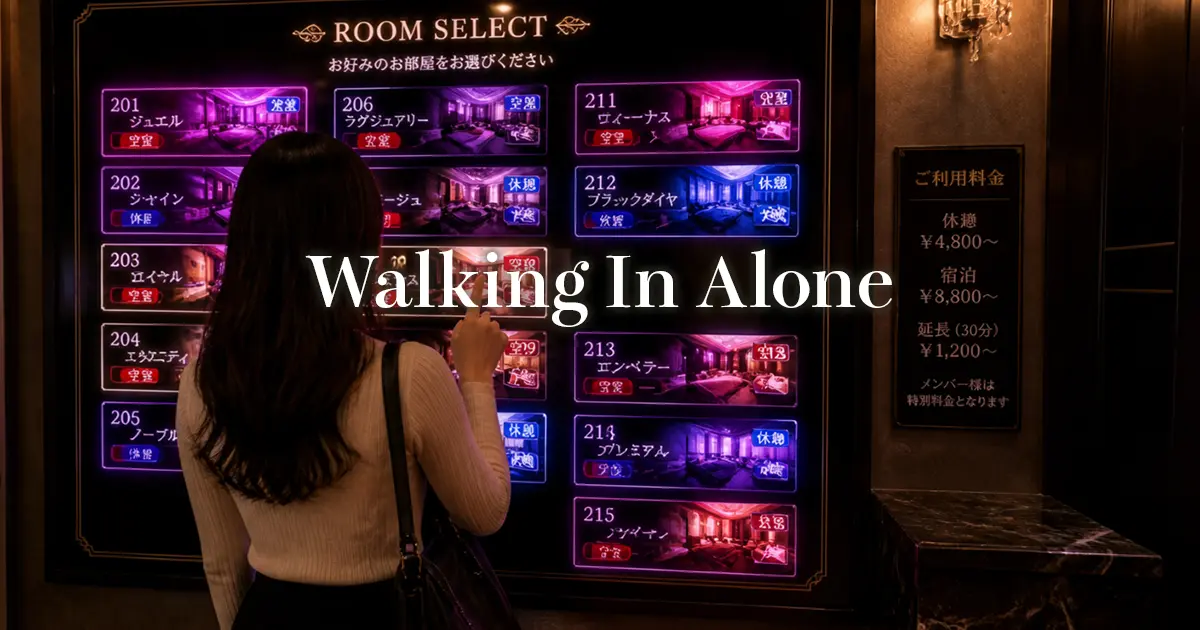
Love hotels are built around anonymity. You step into a small lobby, choose your room from a backlit panel of photos, and either take a key from a machine or exchange a few words with a receptionist behind frosted glass. There’s no open front desk, no bellhop, no lobby full of eyes — in many hotels the entire check-in is automated. The system was designed decades ago to protect couples’ privacy, and it protects yours just as well.
A woman on her own is nothing unusual
Solo use of love hotels has quietly become normal in Japan. People check in alone to nap, to work undisturbed, to soak in a big bath, or to celebrate a favorite idol with friends — and hotels welcome them without a second glance. The one firm rule is legal: love hotels are strictly 18-plus, and staff may ask for ID. Whether you walk in alone or together with your therapist, you’ll be the least interesting thing that happens at that hotel all day.
Cleanliness is a competitive sport
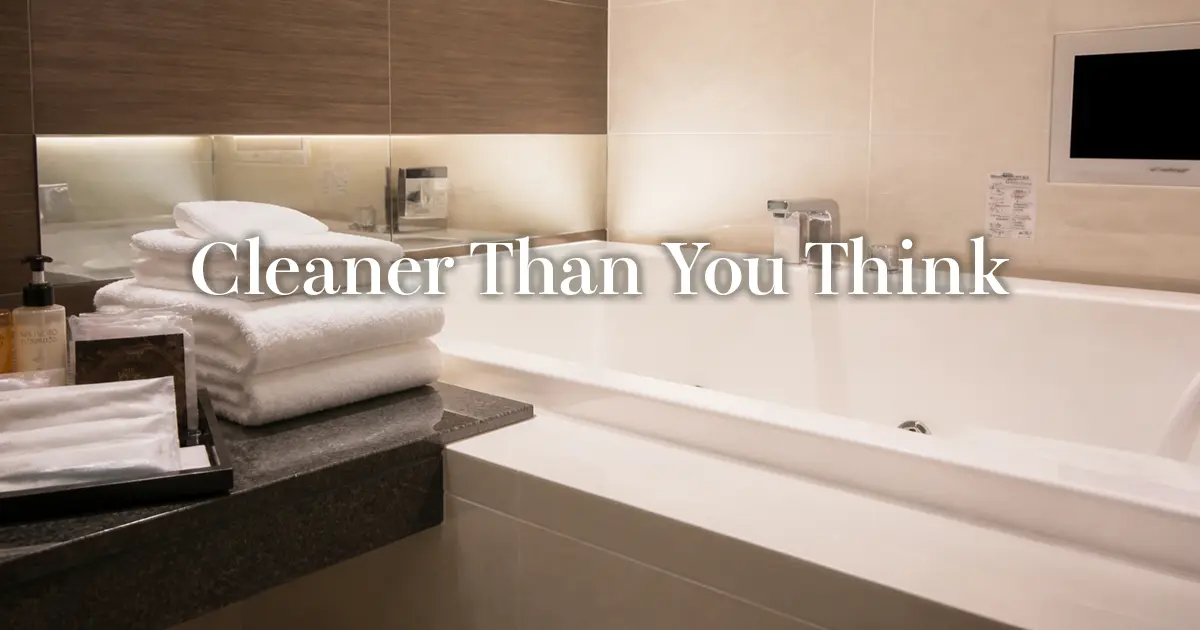
Put the seedy image aside. Tokyo love hotels compete hard on cleanliness and comfort, because reviews are public and guests are picky. Rooms are cleaned between every use, and amenities typically run from shampoo, towels, and toothbrushes to skincare and hair irons — you can arrive nearly empty-handed. Quality varies, though, so vet a hotel the way locals do: compare the official photos with recent guest photos, and trust specific comments — “the bathroom was spotless” — over generic star ratings.
Rest or Stay: The Basics of Using a Love Hotel
Two ways of buying time
Love hotels sell time in two forms: a “rest” of roughly two to three hours, and an overnight “stay.” In Shinjuku, as of 2026, a rest typically runs about ¥4,000–¥8,000 and an overnight stay about ¥8,000–¥16,000, depending on the hotel and the night. The room charge is separate from your session fee, and as the guest you cover it — which also means you choose the room. Pick a rest window comfortably longer than your course: counseling and showers deserve unhurried time, not clock-watching.
Paying is mostly machines
Payment usually happens at an automatic machine — in the room at checkout, or in the lobby up front. Most hotels now take credit cards and e-money, but a stubborn minority remain cash-only, so carry some cash just in case. One more quirk: rests generally can’t be reserved. It’s walk-in only at most hotels, and popular ones fill up on weekend nights, so keep a backup or two in mind.
Which area? A quick Tokyo cheat sheet
Kabukicho, in Shinjuku, is Japan’s largest concentration of love hotels — the widest choice, with plenty of privacy-focused properties. The Shinjuku-sanchome and Gyoen side skews stylish and date-like, while the station’s west and south exits offer fewer but conveniently placed options. There’s a money angle too: MIKADO’s therapist transportation is free to hotels around Shinjuku, Shibuya, Ikebukuro, and Kinshicho stations, and a flat ¥500 anywhere else in the 23 wards. And if you feel like making an evening of it, many hotels come with open-air baths, saunas, karaoke, or surprisingly good food menus.
- Near Shinjuku, Shibuya, Ikebukuro, or Kinshicho station — therapist transportation is free there
- Recent guest photos that match the official ones
- Specific cleanliness comments, not just star counts
- A rest window longer than your course, with room for counseling and showers
- One or two backup hotels nearby for busy nights
How a Love Hotel Session Actually Flows
The meet-up comes first, and it’s simpler than you might fear. The most common pattern is also the easiest: you meet your therapist near the hotel and walk in together — natural, unremarkable, exactly what the building was made for. Alternatively, you can check in first and message him the room number, though it’s worth confirming when you book: many love hotels don’t allow a second person to join after check-in, so entering together is the default.
From there, the session follows the same guest-centered rhythm as any MIKADO booking: unhurried counseling about what you’re curious about and what’s off-limits, a shower at your own pace, and then the treatment itself, unfolding at a tempo your body sets. The full sequence is laid out on the how it works page. What the love hotel adds is atmosphere on your terms — a bath big enough to actually relax in, lighting you can dim to exactly the level that makes you brave, and no housekeeping knocking at the door.
And if it’s not the hotel but the session itself that has your stomach fluttering, there’s a whole article written for exactly that feeling: your first erotic massage in Tokyo, for when you’re nervous.
What the Whole Evening Costs
Transparent numbers, so nothing ambushes you at the machine:
- The session: courses from ¥15,000. Several lengths are available — the current list is on the official pricing page.
- Request fee: ¥1,000–¥10,000 depending on his rank, if you ask for a specific therapist.
- Advance request fee: ¥5,000 when you request a specific therapist two or more weeks ahead.
- Transportation: free around Shinjuku, Shibuya, Ikebukuro, and Kinshicho stations; ¥500 flat elsewhere in the 23 wards.
- The room: your rest fee, as covered above.
- Tipping: none. This is Japan — the price is the price.
Booking works in English, too. The step-by-step booking guide in English walks you through every screen, you can browse English-speaking therapists in Tokyo, or simply call 080-4403-5354 — English is fine on the phone.
Love Hotel Questions Women Actually Ask
Quick answers to the questions that come up most — and for everything else, there’s the full Q&A page.
Do I need to reserve the love hotel in advance?
Usually you can’t — rests are walk-in at almost every hotel. Arrive a few minutes early, pick your room from the panel, and if your first choice is full, your backup is around the corner. In a district like Kabukicho, with dozens of hotels within a few blocks, you will not be left stranded.
Will the staff know why I’m there?
Discretion is the product. Staff don’t ask, don’t comment, and the entire building is engineered to minimize contact — two adults arriving at a love hotel is the single least remarkable sight in the neighborhood. Nobody on the street can tell anything either; entrances are designed to be slipped into.
Can we use my regular hotel room instead?
Often, yes — MIKADO dispatches to hotels and homes across Tokyo. The catch is your hotel’s visitor policy: many international chains only allow registered guests in rooms, so check before you book. If your accommodation is visitor-friendly, the full picture is in the guide to in-room massage in Tokyo. If it isn’t, the love hotel is your clean, private escape hatch.
What should I bring?
Almost nothing. Towels, shampoo, toothbrushes, and basic skincare are standard, and many hotels stock hair irons and more. Bring your own makeup, anything that helps you feel at home — and that’s genuinely it.
The Room Is a Stage. You’re the Whole Show.
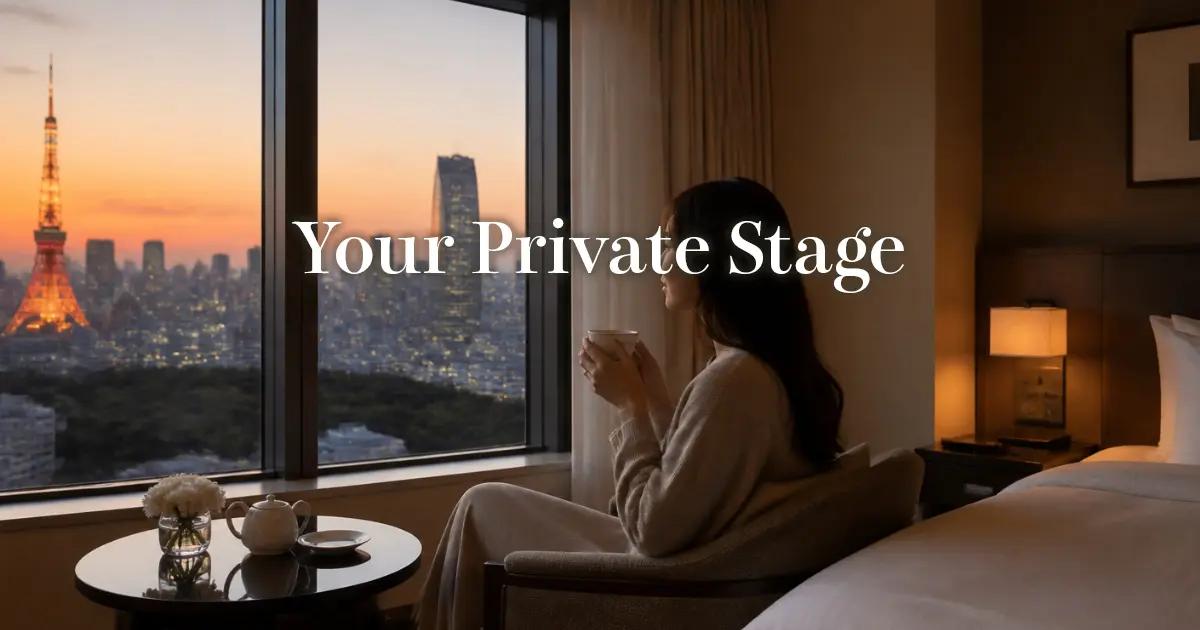
Today, a love hotel might feel like an unfamiliar door. After your first session, it becomes what it always was: logistics. Behind that door is a room built for privacy, a bath drawn for you, and a professional whose only job for the next few hours is your pleasure. You choose the hotel. You set the boundaries. You set the pace.
Or explore everything MIKADO offers.
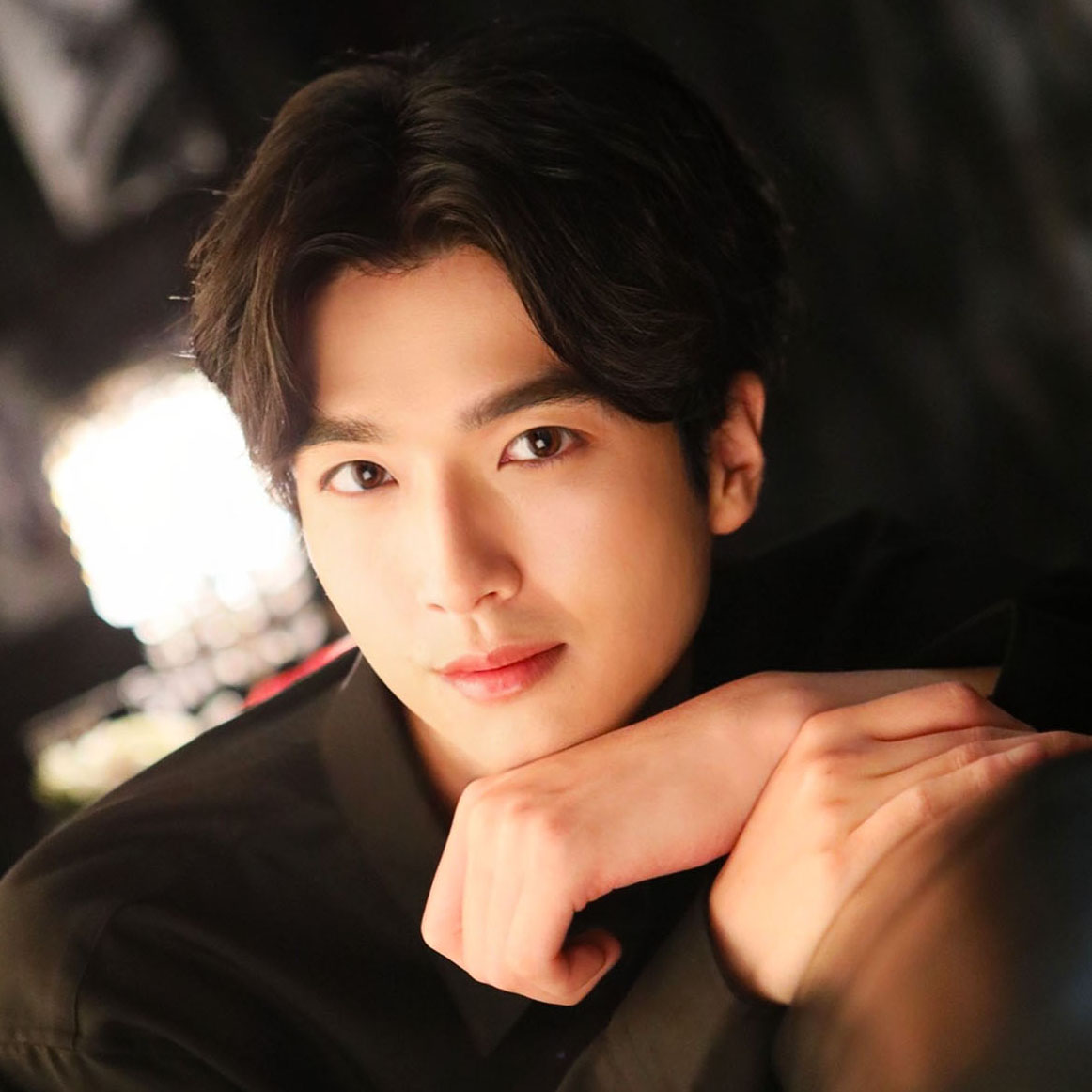
女性用風俗 帝グループのオーナー。セラピストとしても現役で活動しています。
2019年9月にセラピストとしてデビューし、前に所属していた店舗で7ヶ月連続の店舗No.1となり、新人研修の講師も務めました。2021年9月に独立して帝を立ち上げ、帝でも全国No.1を7ヶ月連続で獲得しました。
米国催眠士協会(NGH)認定の催眠療法士。FODショートドラマ「女性用風俗」の監修、ぴゅあらば主催の女風セラピスト総選挙2025で関東1位。各種メディアの出演・取材も受け付けています。
「全ての女性の性の悩みを解決し、本当の快感を知ってもらいたい」という理念のもと、帝グループを全国23店舗で運営しています。


