
You’ve read about it. You’ve thought about it — maybe for weeks, maybe for a year. You know women-only sensual massage exists in Tokyo, and some quiet part of you has already decided. Then you open a booking page and freeze: which therapist, what do you write, where would it even happen, and can any of this be done in English? Yes — all of it. This is the step-by-step guide to actually booking, from first click to the knock on your door.
The example this guide is built on: MIKADO, a women-only sensual massage service — josei-yō fūzoku (女性用風俗), ‘jofū’ for short — founded in September 2021, now with 23 locations nationwide (8 directly managed and 15 franchise), around 140 male therapists, and roughly 40,000 sessions delivered. Among first-time guests, about 60% return. In Tokyo, everything works as outcall: there is no shop and no front desk, because your therapist comes to you.
The Whole Booking Is Three Decisions
Strip the nerves away and booking comes down to three questions: who (your therapist), when (Tokyo sessions run from 08:00 until late at night), and where (your hotel, a love hotel, or your own home). Everything else — the counseling, the shower, the pacing of the session itself — is handled on the day, together, at your speed.
There is no venue to walk into and no counter to stand at. You choose who, when, and where; your therapist handles the rest. The entire booking can be done in written English in about ten minutes.
Still deciding what kind of company you want — conversation, a dinner companion, or a full sensual session? Our guide to how male companionship services for women work in Japan maps that landscape. And if you’re torn between a hotel spa, a wellness salon, a private tantric practitioner, and a women-only service, this comparison of the four kinds of sensual massage in Tokyo lays them side by side. Come back when you know it’s this one.
Step 1: Choose Your Therapist — Profiles, Photo Diaries, Rankings
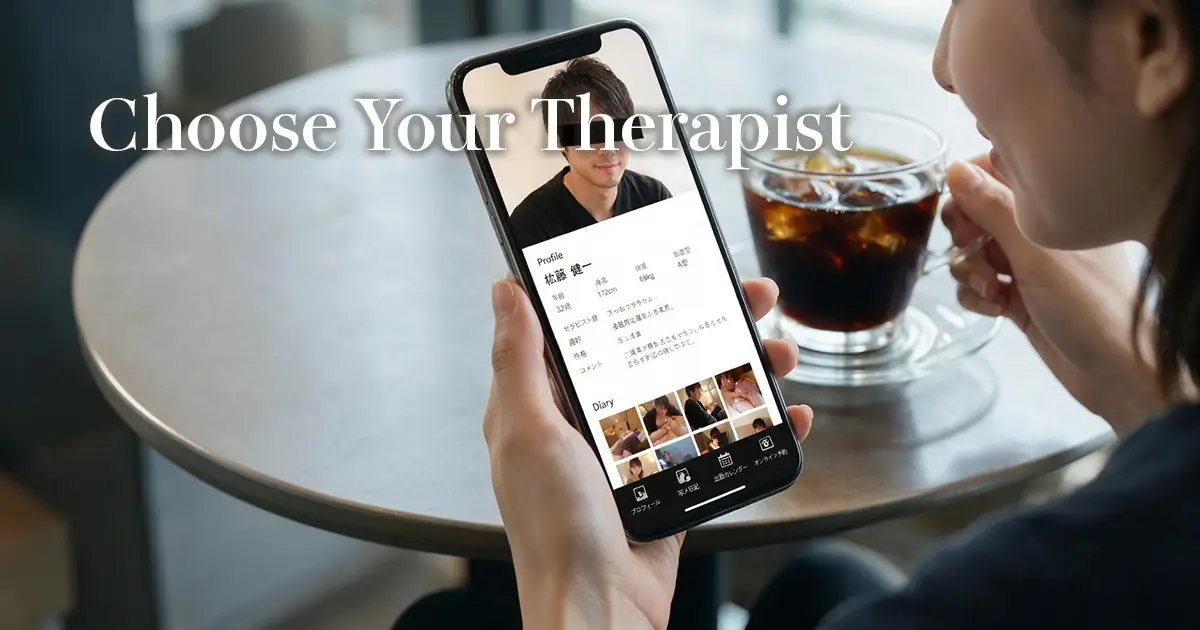
This is the step most women overthink, and the one that becomes genuinely fun once you can read the culture. Start with the full therapist roster — every therapist has a profile with photos, his background, and the kind of session he’s known for. If conversation matters to you (especially in a first session), begin with the English-speaking therapists and browse outward from there.
How to read a photo diary
Japan’s sensual industry has a custom with no Western equivalent: therapists keep photo diaries — sha-me nikki (写メ日記) — short, casual posts about their days, their thoughts, and their gratitude to guests. Think of them as a sincerity test you get to run before spending a yen. Look for consistency (a therapist who posts steadily takes the work seriously), warmth (how he writes about guests — respectful, never boastful), and whether the man in the diary matches the man in the photos. Most diaries are in Japanese; your phone’s translate camera handles them fine, and reading them feels a little like being let in on a secret.
How to read the rankings
The monthly therapist rankings are the other insider signal. They reflect who is being requested most — which means they’re written, in effect, by the women who booked before you, and that makes them more honest than any advertisement. Two practical notes: a top-ranked therapist books up fast and carries a request fee at the higher end of the ¥1,000–¥10,000 range, while a newer or lower-ranked therapist is easier to schedule, lighter on the budget, and every bit as trained and committed.
Step 2: Check the Schedule, Then Book in Plain English
Shortlist in hand, open the working schedule to see which days your therapist is on. Then book one of two ways:
- Online: send the reservation form. Write in English — simple sentences are completely fine, and nobody is grading your grammar.
- By phone: call 080-4403-5354. A detail that says a lot about how English-speaking guests are treated here: calls in English are answered by the owner himself.
Whichever route you take, a good booking message covers:
- Your preferred date and time — plus a backup if you have one
- Your therapist’s name, or ‘first time — please recommend someone English-friendly’
- The course you’re considering (courses start from ¥15,000; browse the full course and pricing list first if you like), or simply ask for advice
- The area you’ll be in, and whether you have a room sorted or want suggestions
- Anything useful to know in advance — first-time nerves, a period that might overlap your date (sessions are still available as a paid option, with a few hygiene-based limits), anything off-limits
One planner’s note: requesting a specific therapist two or more weeks ahead adds a ¥5,000 advance request fee — the price of locking in exactly the man you want, well before anyone else can.
Step 3: Sort Out the Room (Easier Than It Sounds)
‘Where does this actually happen?’ stalls more bookings than any other question, so here is the honest picture. You have three options:
- Your own hotel. If you’re visiting Tokyo, the simplest venue may be the room you already have. Visitor policies vary from hotel to hotel, so check quietly — a front desk will answer ‘can a guest visit my room?’ without asking why.
- A love hotel. Japan’s love hotels are private, immaculate, and built for discretion — you book by the hour, and no one sees anything. They cluster around Shinjuku, Shibuya, Ikebukuro, and Kinshicho stations, which is convenient twice over: therapist transportation to hotels near those four stations is free, and a flat ¥500 anywhere else in Tokyo’s 23 wards.
- Your home. If you live in Tokyo, your own bed is a perfectly normal choice — many guests prefer the comfort of familiar walls.
Unsure which to pick? Say so in your booking message — suggesting a comfortable, session-friendly hotel is a routine part of the job, not an imposition. And for a closer look at how sessions unfold inside a hotel room, our guide to in-room massage at Tokyo hotels goes deep on exactly that.

On the Day: Payment, the No-Tipping Rule, and Cancellations
Your therapist arrives at the agreed time, and the session opens not with touch but with talk — unhurried counseling about what you want and don’t want, then a shower, then the session itself. For the full picture of how it all feels from the inside, read our first-timer’s guide to what actually happens during a session.
“Everything happens at your pace. Your only job is to relax.”— the reassurance experienced guests keep offering nervous first-timers
Your total is simple arithmetic: course price + request fee (¥1,000–¥10,000, by rank) + transportation (free near the four covered stations, ¥500 elsewhere in the 23 wards). That’s the entire number for standard hours. No service charge, no hidden extras — and no tip. (A late-night start or finish can add a small surcharge — confirm when you book.)
On tipping: Japan doesn’t do it, and this industry is no exception. Your therapist neither expects nor needs an envelope, and there’s no awkward mental math at the end of the night. If the session moved you, book him again — a repeat request is the compliment that actually counts here.
If plans change, tell the team as early as you can — and if your dates are genuinely uncertain, ask about the current cancellation terms when you book, so there are no surprises either way.
If that one line raises the bigger question — is any of this actually legal? — the full answer is worth reading. Our guide to how Japan regulates its women-only sensual services explains where the law draws the line and what that means for you as the guest.
Privacy: Who Will Know? Only Whoever You Tell
Discretion isn’t a promise stapled on afterward — it’s built into the outcall model. There’s no storefront to be seen entering, no waiting room, no chance of meeting a neighbor in a lobby chair. Your booking details stay between you and the service, and your therapist arrives like any ordinary visitor. Some guests tell their best friend everything the next morning; plenty tell no one at all. Both are exactly as it should be — what you did with your evening is yours.

The Questions Women Actually Ask Before Booking
These four come up again and again in women’s forum threads. Straight answers:
Is it OK if I’m married?
Yes. Married and partnered women book sessions every day, and no one will ask you to explain yourself — not when you book, not during counseling, not ever. Whether you share it with your partner or keep it private is your decision alone, and discretion is treated as part of the service, not a favor. Wanting to be touched and prioritized after years of going without doesn’t make you a bad partner. It makes you human.
Will he judge my body?
No — and this fear deserves a direct answer, because nearly every first-timer carries some version of it. Therapists work with real women of every age, size, and shape, session after session, year after year. His attention is trained on how your body responds, not how it compares — and there is no body he hasn’t welcomed. You will not be the exception. There is no exception.
Can I just talk and cuddle?
Yes. The sensual part is a ceiling, not a floor. Some guests spend most of a session talking, being held, or dozing beside another warm human being, and therapists meet that request with exactly the same professionalism. Say so in counseling — nothing proceeds without your lead — and if closeness without intensity is what you’re after from the start, lighter options such as date-style courses exist on the pricing page too.
What if I get attached to my therapist?
It happens, and it isn’t a malfunction — skilled warmth and attentive touch are designed to feel good, and feelings sometimes follow. The structure is what protects you: the relationship lives inside sessions, with clear professional boundaries on his side and total freedom on yours. Many guests settle into a rhythm that works — a monthly session with someone they trust, enjoyed for exactly what it is. If the feelings ever start to feel bigger than the sessions, you can change therapists or pause without explanation, and talking it through with a counselor is a perfectly reasonable step too.
That’s the whole mountain — and up close, it’s a staircase. Find the therapist whose diary makes you smile, check his schedule, write five plain-English sentences, and let the team solve the hotel question with you. The hardest part was deciding you deserved this. The rest is ten minutes of typing.
Or explore everything MIKADO offers.

女性用風俗 帝グループのオーナー。セラピストとしても現役で活動しています。
2019年9月にセラピストとしてデビューし、前に所属していた店舗で7ヶ月連続の店舗No.1となり、新人研修の講師も務めました。2021年9月に独立して帝を立ち上げ、帝でも全国No.1を7ヶ月連続で獲得しました。
米国催眠士協会(NGH)認定の催眠療法士。FODショートドラマ「女性用風俗」の監修、ぴゅあらば主催の女風セラピスト総選挙2025で関東1位。各種メディアの出演・取材も受け付けています。
「全ての女性の性の悩みを解決し、本当の快感を知ってもらいたい」という理念のもと、帝グループを全国23店舗で運営しています。


