
You’ve done the reading. Maybe you’ve browsed therapist profiles, compared courses, even drafted the booking message — and then one last question stopped your thumb: wait, is this actually legal? It’s the most sensible question you could ask before booking a sensual massage in a foreign country, and it deserves a real answer rather than forum guesses. Here’s how Japan actually regulates its women-only sensual services, what that framework means for you as a guest, and how to recognize a service that takes the rules as seriously as you do.
The Short Answer: Yes — This Industry Operates Legally
Let’s not bury it. Women-only sensual massage in Japan is not an underground scene, and it is not a gray zone that could collapse mid-booking. It belongs to an established, government-regulated industry — known in Japanese as josei-yō fūzoku (女性用風俗), or “jofū” for short — in which businesses declare themselves to the authorities before they ever take a reservation.
Japan’s approach to adult services is regulation, not prohibition. Legitimate outcall sensual services file a formal notification with the authorities before operating — and every obligation in that framework sits with the business, not with you as the guest.
MIKADO, the service behind this guide, has operated inside that framework since September 2021, growing to 23 locations nationwide — 8 directly managed and 15 franchise — with around 140 male therapists and roughly 40,000 sessions delivered. Among first-time guests, about 60% return. Businesses do not grow like that in plain sight, with published pricing and public therapist profiles, by operating outside the law.
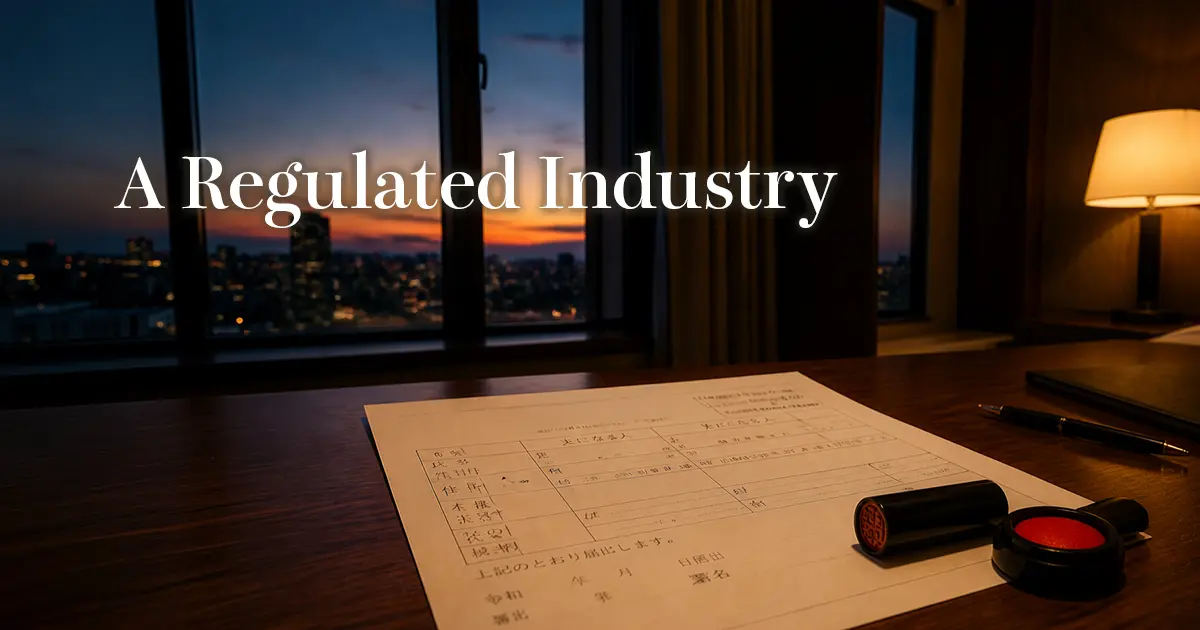
How Japan’s Legal Framework Actually Works
A notification system, not a free-for-all
Broadly speaking, outcall adult services in Japan operate under a notification system: before opening, a business files formal paperwork with the public safety authorities in its prefecture. Once notified, it is subject to rules about how it may operate and advertise. This is why the phrase “legal gray zone” — which you may have seen on older blogs — misses the mark for properly run services. A notified business isn’t hiding from the law; it’s on file with it.
The one bright line
One legal boundary defines the industry more clearly than any other, and it’s worth spelling out so you can understand the system rather than just trusting it: Japanese law — noted here purely to explain the legal landscape — prohibits paid sexual intercourse. Every legitimate sensual service for women is designed to remain unambiguously on the lawful side of that line.
What This Means for You, the Guest
“I’d love to try something like this while I’m in Tokyo, but I’m honestly worried about getting caught doing something illegal.”— the worry women researching Japan’s sensual services most often describe
If that sentence could be yours, here is the part that should let your shoulders drop: the framework above regulates businesses. The notification requirements, the operating rules, the advertising restrictions — all of it binds the operator. Booking a session doesn’t require you to register anywhere, sign anything official, or interact with any authority. You are simply the customer of a lawful service, in the same position you occupy when you book any other professional appointment during your stay.
“Getting caught” also assumes there is something to catch. In Tokyo, MIKADO works entirely as an outcall service: your therapist comes to your hotel room or your home, arriving like any other visitor. There is no storefront to be seen entering, no sign over a door, no waiting room. The most private version of this experience is the standard version.
And if your real worry is less about the law and more about the person — who these therapists are, how they’re screened, what it feels like to be alone in a room with one — that deserves its own answer: read what a session with a male therapist is actually like.
How a Well-Run Service Protects You
Operating legally is the baseline. A service built for women should then add its own layers of protection on top. Here is what that looks like in practice at MIKADO:
- Every session begins with counseling. Before anything else happens, you and your therapist talk — about what you want, what you’re unsure about, and what is off-limits. Boundaries are set by you, and you can pause or stop at any time. The full session flow is published step by step, so nothing has to be a mystery.
- Women-only means women-only. Male clients are not accepted. The entire service, from therapist training to etiquette, is designed around female guests.
- Transparent, published pricing. Courses start from ¥15,000, and the details live on the official pricing page — no quotes whispered over the phone, no surprise additions at the door.
- English, without the anxiety. There are English-speaking therapists in Tokyo, and English calls to 080-4403-5354 are answered personally by the owner. Tokyo sessions run from 08:00 until late at night.
Legal Is the Floor — Choosing a Service That Respects It
One honest caveat: “this industry is legal” does not mean every operator inside it is equally careful. Legality tells you the industry exists in the open; it doesn’t vet each business for you. So here is a short field guide — the signals that a service treats the rules, and you, with respect:
- Pricing is published in full, before you ever have to ask
- The boundaries of a session are stated openly — including what does not happen
- A women-only policy is explicit, not implied
- Therapists have real, browsable profiles with photos and schedules
- A counseling conversation comes before any touch, with a stated right to stop at any time
- Your questions are welcomed before you commit — a service at ease with the law is at ease with scrutiny
If you want the wider map of what exists in Tokyo beyond massage — including the strictly platonic corners of the industry — the guide to how Japan’s laws shape the male companionship scene lays it out, and the complete first-timer’s guide to erotic massage for women covers the experience itself in depth.
FAQ: The Legal Questions Women Actually Ask
Can I get in trouble for booking a session?
The regulatory framework is aimed at operators, not guests. Booking a sensual massage doesn’t involve you in any notification or registration process — those obligations belong to the business. Practically speaking, you book, you enjoy your session, and your involvement with Japanese administrative law ends before it begins. If you have a specific personal concern — one connected to your profession, for example — a qualified professional is the right person to ask; this article can’t advise on individual situations.
Does it matter that I’m a foreigner, or here on a tourist visa?
The rules that govern this industry concern the operator’s paperwork, not the guest’s passport. Foreign guests — travelers and residents alike — book sessions, and MIKADO welcomes them in English. Enjoying a personal service while visiting Japan is exactly as unremarkable, in legal terms, as booking a spa day or a private tour.
Is it legal for a therapist to come to my hotel room?
Outcall is the standard, declared structure of this industry — sessions happen in hotel rooms and private homes across Japan every day. Your therapist arrives dressed like any other professional and behaves with complete discretion. If you’re wondering about the practical side — which hotels work best, how to time the arrival, what to say at the front desk (usually: nothing) — the step-by-step English booking guide walks through the logistics.
Does “legal” mean every service is automatically trustworthy?
No — and any service that implies otherwise is skipping a step. Legality is the floor; the checklist above is how you evaluate what’s built on it. Take your time, compare, and ask questions before you commit. Anything this article hasn’t covered, the full Q&A page likely has.
The Question Behind the Question
For many women, “is it legal?” is quietly standing in for a different question: “am I allowed to want this?” The law has an answer to the first — a regulated industry, operating in the open, built so that nothing about your evening depends on looking over your shoulder. The second question was never the law’s to answer. It’s yours. And whatever you decide, you now know that the only thing standing between you and this experience is a choice — not a risk.
Or explore everything MIKADO offers.

女性用風俗 帝グループのオーナー。セラピストとしても現役で活動しています。
2019年9月にセラピストとしてデビューし、前に所属していた店舗で7ヶ月連続の店舗No.1となり、新人研修の講師も務めました。2021年9月に独立して帝を立ち上げ、帝でも全国No.1を7ヶ月連続で獲得しました。
米国催眠士協会(NGH)認定の催眠療法士。FODショートドラマ「女性用風俗」の監修、ぴゅあらば主催の女風セラピスト総選挙2025で関東1位。各種メディアの出演・取材も受け付けています。
「全ての女性の性の悩みを解決し、本当の快感を知ってもらいたい」という理念のもと、帝グループを全国23店舗で運営しています。


