
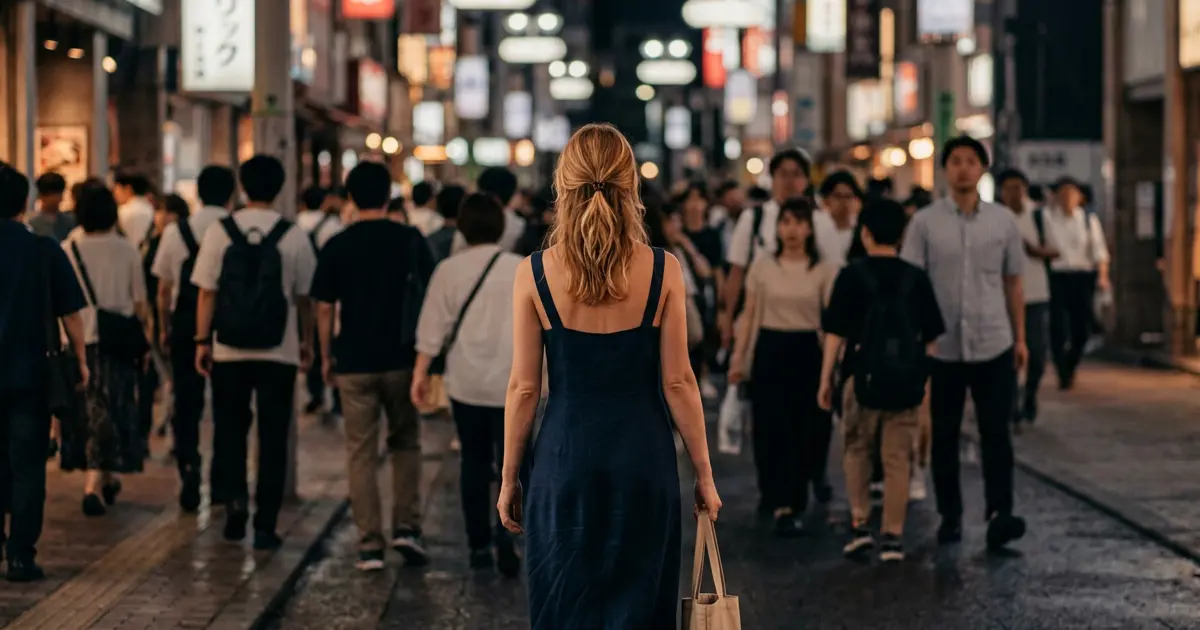
There’s a Japanese word most foreign residents learn early: skinship — casual, affectionate touch between people who are close. And there’s a quiet observation many women make not long after: in daily life here, skinship is mostly a word. Friends don’t hug hello. Coworkers don’t touch your arm when they laugh. Couples rarely hold hands past a certain age. You can be surrounded by 37 million people in Greater Tokyo and go months — sometimes years — without being meaningfully touched by another human being.
If you found this page by typing “touch starved” at two in the morning, you already know how that feels from the inside. This guide is for you: what touch starvation (sometimes called skin hunger) actually is, why living in Japan tends to make it worse rather than better, and the realistic options women here have for getting touch back into their lives — from the free and simple to the professional and unapologetically indulgent.
What Being Touch Starved Actually Means
Touch starvation is the state of getting far less physical contact than your body and mind are wired to expect. It isn’t a formal medical diagnosis, but the experience is well documented, and the touch starvation symptoms women describe are strikingly consistent:
- A physical ache or restlessness that food, sleep, and exercise don’t fix
- Feeling weirdly emotional at small moments of contact — a hairdresser’s hands, a crowded train, a friend’s brief hug
- Wrapping yourself in weighted blankets, long baths, or your own arms just to feel pressure on your skin
- Irritability, flat mood, or trouble sleeping with no obvious cause
- Watching couples on the street and feeling a spike of longing that borders on grief
None of this means anything is wrong with you. Touch is a need, not a luxury — affectionate contact is deeply tied to how our bodies regulate stress and mood. Remove it for long enough and most people start to fray at the edges. That’s not weakness; that’s biology doing exactly what it’s supposed to do.

“Why Do I Crave Physical Touch So Badly?”
Because you’re human, and possibly because you’re running on a longer deficit than you realize. The craving tends to intensify, not fade, the longer you go without contact — which is why it can feel strangely overwhelming after a breakup, a move abroad, or a long stretch of remote work. Many women also notice the craving gets tangled up with desire: it becomes hard to tell whether you miss sex, miss touch, or simply miss being wanted. (Often it’s all three, and they respond to different remedies — more on that below.)
What the craving is not: needy, embarrassing, or something you should be able to logic your way out of. You can’t think your way to feeling held, any more than you can think your way to feeling fed.
Why Living in Japan Makes It Worse
Japan is a wonderful place to live and a genuinely difficult place to be touched. A few structural reasons:
Low-contact culture. Daily life here is built around respectful distance. Bowing replaces handshakes and hugs; friends and even family often show love through acts and attention rather than physical affection. If you grew up somewhere where greetings involve contact, the baseline drop is dramatic — and it happens silently, so you may not connect the dots for months.
Touch fades inside relationships, too. Physical affection between couples tends to taper off here earlier and more completely than many foreign women expect, and national surveys have repeatedly found that close to half of married couples in Japan describe their marriage as sexless — and more recent surveys suggest even more. Living with a partner is no guarantee of being touched — a reality we’ve written about in depth in our guide to sexless marriage in Japan.
Smaller social safety nets. If you moved here from abroad, the friends who would have hugged you are eight time zones away. Building new friendships in Japan takes time, and even close local friendships may never become physically affectionate ones.
The paradox of the crowded city. Tokyo presses strangers against you on the train every morning while making warm, wanted touch scarce. Incidental contact without intimacy can leave you feeling more starved, not less — your skin gets contact, but you get nothing.
Put those together and a pattern emerges: touch starvation in Japan is common, structural, and almost never talked about. It is not a personal failure. It’s the predictable result of an affectionate person living in a low-touch environment.

What Women in Japan Can Actually Do About It
There’s no single right answer here — different women need different kinds of touch, and what helps depends on whether your hunger is social, physical, or sensual. Think of the options as a ladder, from lightest to most intimate:
1. Build touch into your routine. Partner dance classes, yoga with hands-on adjustments, regular hair and nail appointments — activities where safe, structured contact is part of the deal. These won’t fill a deep deficit, but they raise your baseline and cost little.
2. Conventional bodywork. Japan is rich in massage: shiatsu, aromatherapy salons, hotel spas. A skilled sixty-minute massage delivers real, sustained human contact and is the easiest professional option to book anywhere in the country. The limit is the framing — it’s therapeutic, efficient, and emotionally neutral. You’ll be touched, but not attended to.
3. Paid companionship and cuddle services. Tokyo has a small ecosystem of services built around platonic closeness — cuddle cafes, rent-a-date companions and more — though most cater mainly to male customers and women-friendly options are limited. Quality and English support vary widely, so it pays to understand the landscape before you book. We’ve mapped the whole spectrum, with prices and honest pros and cons, in our guide to paying for touch in Tokyo.
4. Women-only sensual massage. If what you’re missing isn’t just contact but warmth, attention, and desire — being touched as a woman, not as a body on a table — Japan has a legal, established category built precisely for that, described below.
When It’s More Than Skin Hunger
Here’s the honest part most touch-starvation articles skip: for many women, the ache isn’t only about hugs. It’s about going unseen and undesired for so long that your own body starts to feel like a stranger. A friendly cuddle doesn’t reach that. A clinical massage doesn’t either.
Japan’s answer is a category called josei-yō fūzoku — women’s sensual service. A trained male therapist comes to your hotel or home (the service is outcall), and a session begins not with touch but with conversation: what you’re hoping for, what you’re nervous about, where your boundaries are. Every boundary is yours to set, and nothing proceeds without your comfort. After a shower, the session unfolds as a full-body relaxation massage that gradually — only at your pace — becomes warmer and more sensual. In accordance with Japanese law, there is no sexual intercourse (penetration). And precisely because that boundary is fixed, therapists devote their skill to every other path to pleasure and closeness — unhurried, generous touch with no expectation that you give anything back.
MIKADO is one of the largest names in this industry: women-only since its founding in September 2021, with 23 locations across Japan, around 140 male therapists, and around 40,000 sessions delivered to date. Among first-time guests, about 60% return. Men cannot book — every detail of the service exists for female guests, including English-speaking therapists you can filter for on the English-OK therapist page. Sessions in Tokyo start from ¥15,000 (Intimate Body Treatment course), with current courses and prices on the official pricing page. If you’re curious how a first session actually goes, our first-timer’s guide to erotic massage for women in Tokyo walks through it honestly, step by step — and this page covers the flow from booking to goodbye.
Is it for everyone? No — and it shouldn’t be pitched that way. But if your touch starvation has a layer that platonic options can’t reach, it’s worth knowing that a professional, women-first answer exists, and that it’s legal, structured, and bookable in English.
When to Talk to a Professional
Touch starvation overlaps with loneliness and low mood, and sometimes it’s the smaller piece. If you’ve been experiencing persistent sadness, anxiety, sleep problems, or loss of interest in things you used to enjoy, please treat that as a signal worth taking to a doctor or counselor — Tokyo has English-speaking mental health professionals, and reaching out is a strength, not an admission of defeat. Touch can soothe a hard season; it isn’t a substitute for care when something deeper is going on.
But if what you have is skin hunger — the ordinary, human ache of living in a low-touch country — then the fix is refreshingly concrete: get touch back on your calendar, in whatever form fits you. Your body has been asking politely for a long time. It’s allowed to get an answer.
Or explore everything MIKADO offers.

女性用風俗帝オーナー兼セラピスト。
FODショートドラマ「女性用風俗」監修。ぴゅあらば全国セラピスト総選挙、関東部門・第一位。
某大手店舗で全国ランカー、7ヶ月連続の店舗NO1セラピストとして活躍し、新人研修の講師を経験した後、2021年9月に独立。各種メディア出演、取材可です。「全ての女性の性の悩みを解決し、本当の快楽を知ってもらいたい」という理念を掲げ、帝グループのお店を全国23店舗で運営中。


