

There’s a sentence we hear more often than almost any other. It usually comes out quietly, during the counseling conversation before a session, eyes fixed somewhere off to the side: “I’ve never had an orgasm with a partner. I can get there alone. But never with another person. Is something wrong with me?”
Let’s be clear about who’s talking here. We’re not doctors, and this isn’t a clinic. MIKADO is a women-only sensual massage service in Japan — around 140 trained male therapists and roughly 40,000 sessions since our founding in September 2021. What that number means is that we’ve had this exact conversation more times than we can count, with women in their twenties and women in their sixties, married and single, confident and shy. And the pattern behind the sentence is remarkably consistent. This article is what we’ve observed — offered not as treatment, but as an honest report from one of the few rooms where women say this out loud.
First: You’re Not Broken, and You’re Nowhere Near Alone
If you’ve never had an orgasm with a partner, the loneliest part is usually not the orgasm. It’s the secrecy. Women tell us they’ve carried this for ten, fifteen, twenty years without telling a single person — not partners, not friends, not doctors. One woman put it this way: it felt like a confession she’d guarded her whole adult life.
Yet sex researchers have documented for decades that women reach orgasm far more reliably alone than with a partner — the gap is one of the most consistent findings in the entire field. Whatever else that means, it means this: a body that works perfectly well on its own but goes quiet in company is not a malfunctioning body. It’s an extremely common one, responding to something about the situation rather than something about you.
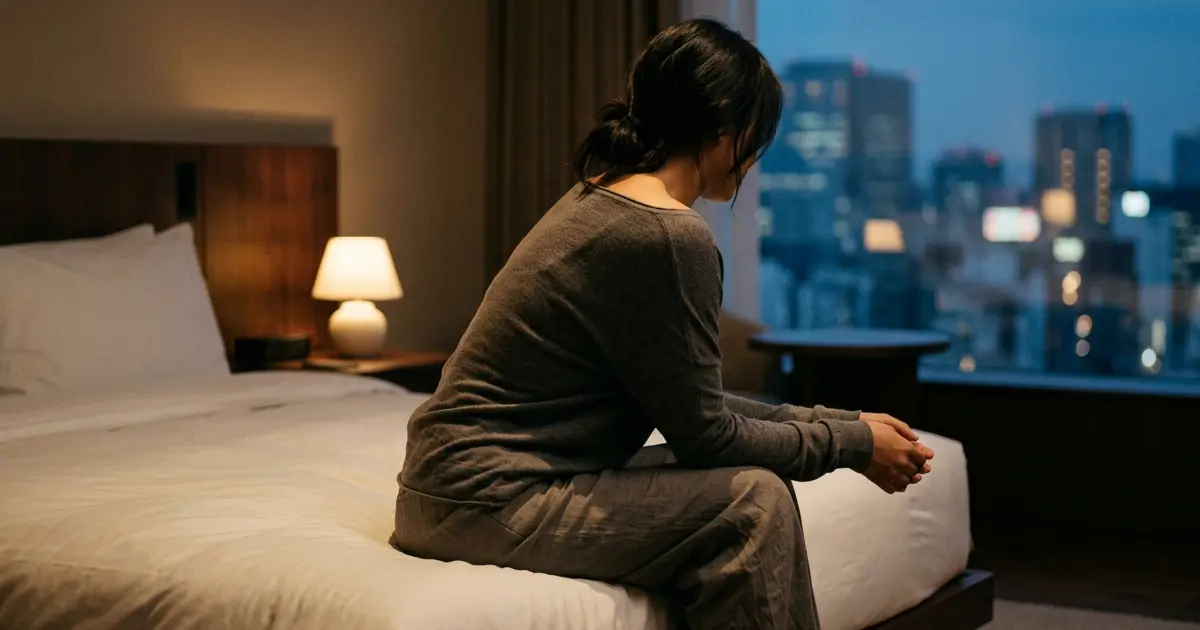
“I Can Orgasm Alone, But Not With a Partner” — What’s Actually Different?
Think about what’s true when you’re alone. You control the pressure, the rhythm, the timing, and the stopping point. Nobody is watching your face. Nobody’s feelings depend on the outcome. You’re not calculating how long is too long, whether his hand is getting tired, or what your stomach looks like from that angle. Your attention has exactly one job: noticing what feels good.
Now count what changes the moment another person enters the room:
- An audience appears. Part of your mind leaves your body and starts watching yourself from the outside — researchers call it spectatoring, and it’s arousal’s natural enemy.
- A clock appears. “Is this taking too long?” is possibly the single most orgasm-proof thought a human being can have.
- Someone else’s ego appears. His effort, his hopes, his need for the evidence that he did well. Many women manage a partner’s feelings mid-act the way they manage everything else — quietly, competently, and at their own expense.
- The reciprocity math appears. He did this, so you owe that. Receiving without a running tally is something many women have literally never experienced.
None of these are flaws in you. They’re conditions. And conditions can be changed — which is the single most hopeful thing we’ve learned.
What 40,000 Sessions Taught Us About Why
Three observations, from years of sessions built entirely around women receiving.
1. It’s almost never the body. The same body that “doesn’t work” with a partner is the one that works fine alone. What we see again and again is that the block sits upstream of sensation — in vigilance, not in nerve endings. A woman who feels watched, hurried, or responsible for someone else’s experience is doing three jobs at once, and pleasure is the job that gets dropped.
2. The apology reflex runs deep. Women apologize to our therapists constantly — “sorry, I’m slow,” “sorry, my body is difficult,” “sorry, this must be boring for you.” Years of hurried encounters teach a woman that her arousal is an inconvenience on someone else’s schedule. Unlearning that takes more than willpower; it takes repeated experience of the opposite.
3. When nothing is expected back, the body behaves differently. A session has no scoreboard. The therapist wants nothing in return, there’s no timetable to beat, and there is no result you’re supposed to produce. Some guests, in that setting, experience their first climax with another person — sometimes after decades of believing it was impossible. Others don’t, and enjoy hours of unhurried touch that ask nothing of them, which many describe as its own quiet revelation. We want to be honest here: a session is not a guaranteed outcome, and it isn’t a test you can fail. The point is what becomes possible when the pressure leaves the room.

When to Talk to a Doctor First
Some situations deserve medical eyes before anything else, and we’d rather lose a booking than skip this paragraph. If you’ve never been able to orgasm under any circumstances — including alone — and it distresses you, that pattern has a recognized clinical name (female orgasmic disorder) and is worth discussing with a gynecologist or a qualified sex therapist. The same goes if sex is painful, if things changed after starting a medication such as an antidepressant, or after childbirth, surgery, or menopause. These can have physical causes that no amount of relaxation will address, and treating them is a doctor’s job, not ours. If you’re in Japan, we’ve put together an honest guide to English-friendly help for sexual problems in Tokyo — clinics, therapists, and where a body-based experience like ours does and doesn’t fit.
What a Pressure-Free Session Actually Looks Like
For the situational kind — works alone, shuts down in company — here is what the experience we offer involves, plainly described.
A trained male therapist comes to your hotel or home (the service is outcall). Nothing starts with touch: it starts with conversation about what you’re hoping for, what you’re nervous about, and where your boundaries are. Every boundary is yours to set, and nothing proceeds without your comfort. After a shower, the session unfolds as a slow full-body massage that becomes warmer and more sensual only at your pace. In accordance with Japanese law, there is no sexual intercourse (penetration). And because that line is fixed, the entire craft of the work goes into everything else — unhurried, attentive touch with no expectation that you give anything back, no clock you can feel, and no face you have to manage.
MIKADO has been women-only since its founding: 23 locations across Japan, and among first-time guests, about 60% return. Men cannot book. Sessions in Tokyo start from ¥15,000, with current courses on the official pricing page, and you can filter for English-speaking therapists on the English-OK page. If you want to know exactly how a first session goes, minute by minute, our first-timer’s guide to erotic massage for women in Tokyo walks through it, and this page covers the flow from booking to goodbye. Is a session the answer for every woman who’s never climaxed with a partner? No — and anyone who promises you a guaranteed result is selling something. It’s one honest option, built specifically around removing the conditions that get in the way.

If You’re Reading This for Your Partner
Maybe you searched “how to help my wife orgasm” and ended up here. The fact that you’re reading is already a good sign — and the most useful thing we can tell you is counterintuitive: stop making her orgasm your mission. A partner’s determined, goal-focused effort is often experienced from her side as one more performance to manage; the harder you aim at the result, the more watched she feels, and the further it recedes. What helps is what our therapists practice — time without a deadline, touch without a target, and genuine indifference to whether tonight “succeeds.” Ask her what she’d enjoy rather than what works. And if you’d like to see what unhurried, receiving-centered touch looks like in practice, some couples book exactly that: our women-first couples course, where she receives and you stay in the room — something you decide together, never a surprise.
One more thing, for her and for you: overthinking during intimacy has its own tangled roots, and we’ve written about them separately in why you can’t relax during sex. The short version is the same as this article’s: the problem was never that your body is broken. It’s that nobody ever gave it the conditions to answer.
Or explore everything MIKADO offers.

女性用風俗帝オーナー兼セラピスト。
FODショートドラマ「女性用風俗」監修。ぴゅあらば全国セラピスト総選挙、関東部門・第一位。
某大手店舗で全国ランカー、7ヶ月連続の店舗NO1セラピストとして活躍し、新人研修の講師を経験した後、2021年9月に独立。各種メディア出演、取材可です。「全ての女性の性の悩みを解決し、本当の快楽を知ってもらいたい」という理念を掲げ、帝グループのお店を全国23店舗で運営中。


